 Ant Laboratory
Version 2.1 · On the App Store since 30 October 2026
What’s new in 2.1, Hunters & Gatherers
Ants that hunt together, a new wooden home for turtle ants, a lovelier cabin and island, and a games folder on the lab computer. 2.1 is free for everyone who has the game, on iPhone, iPad and Macs with Apple silicon, and it is rolling out to Android early access too.
Your colonies open as you left them. Every colony saved by an earlier version carries on where it was.
- Hunt and carry together
- A new home for turtle ants
- A prettier cabin and island
- ANT OS Games
- Ants that move like ants
- Also new
- Better
- Earlier: 2.0, The Naturalist
Hunt and carry together
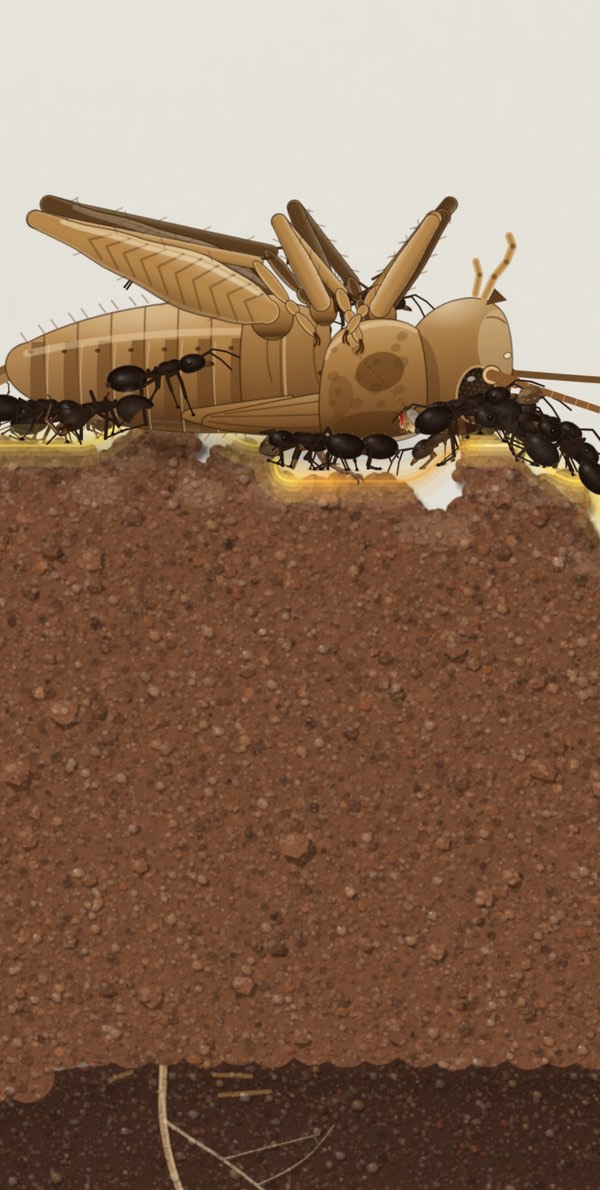
Meat-eating ants now chase live crickets and fruit flies, bite, call their nestmates and drag the prey home as a team. At the door they cut it up and carry the pieces in. A cricket’s last moments look real: it struggles, is torn apart at the door and carried in piece by piece. Vegetarian ants leave live prey alone.
A new home for turtle ants
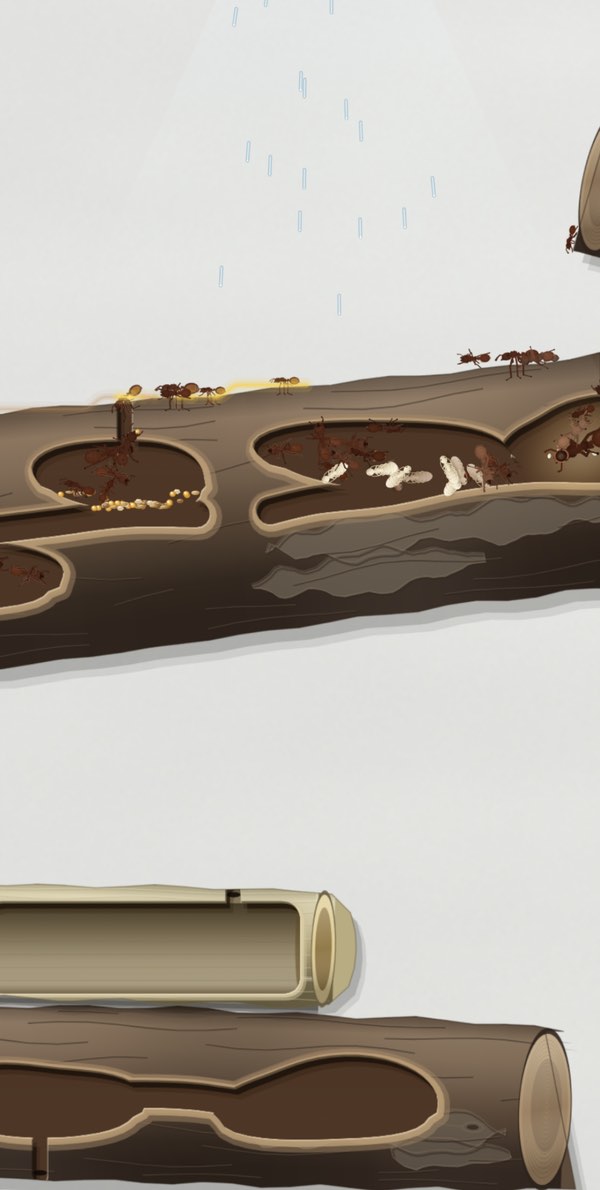
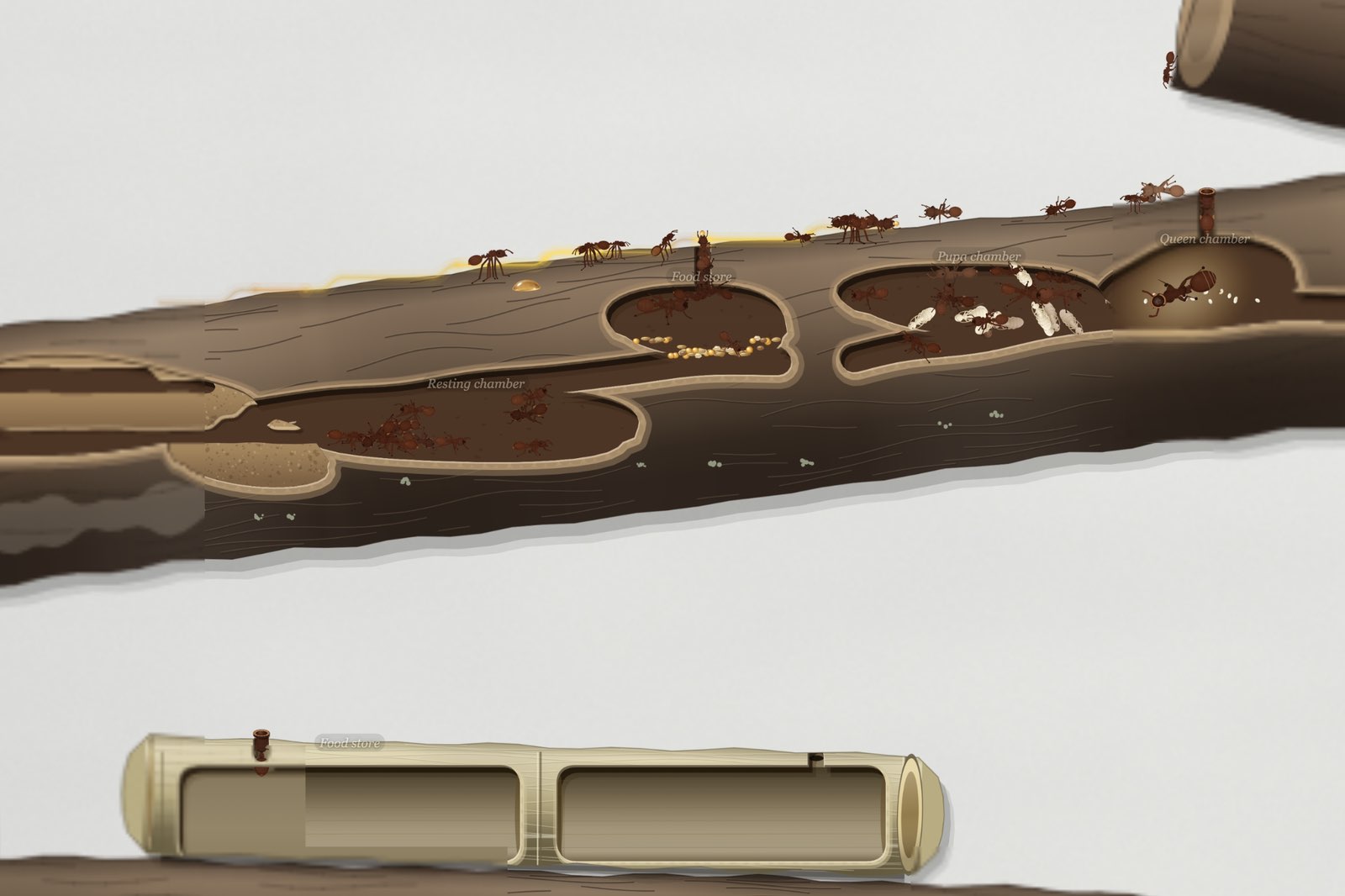
The seventh species, the turtle ant (Cephalotes varians), lives in a network of sticks, forks, branches and bamboo, with bridges between them. They move in through small round doors, and soldiers stand guard at each one, as in real colonies.
A prettier cabin and island
Better light and shade in the cabin, hills and valleys on the island map, which looks brighter from far out, and softer, rounder tunnels and rooms in the farm.
ANT OS Games
The computer in the lodge has a new Games folder. Play Ant Arcade (Scent Trail, Seed Run and Ant Trails), Aphid Ranch and Leaf Cutter, and The Long Way Home, a brand-new platformer: guide a lost scout ant through a 1990s kitchen, pantry and sink to get home.
Ants that move like ants
They turn round instead of walking backwards. Their feet stay on the soil, their bodies roll and turn in depth, and they keep inside the tunnels. The queen walks calmly.
Also new
- Live fruit flies and crickets, strawberries and blueberries, and leaves for the leafcutters to cut up.
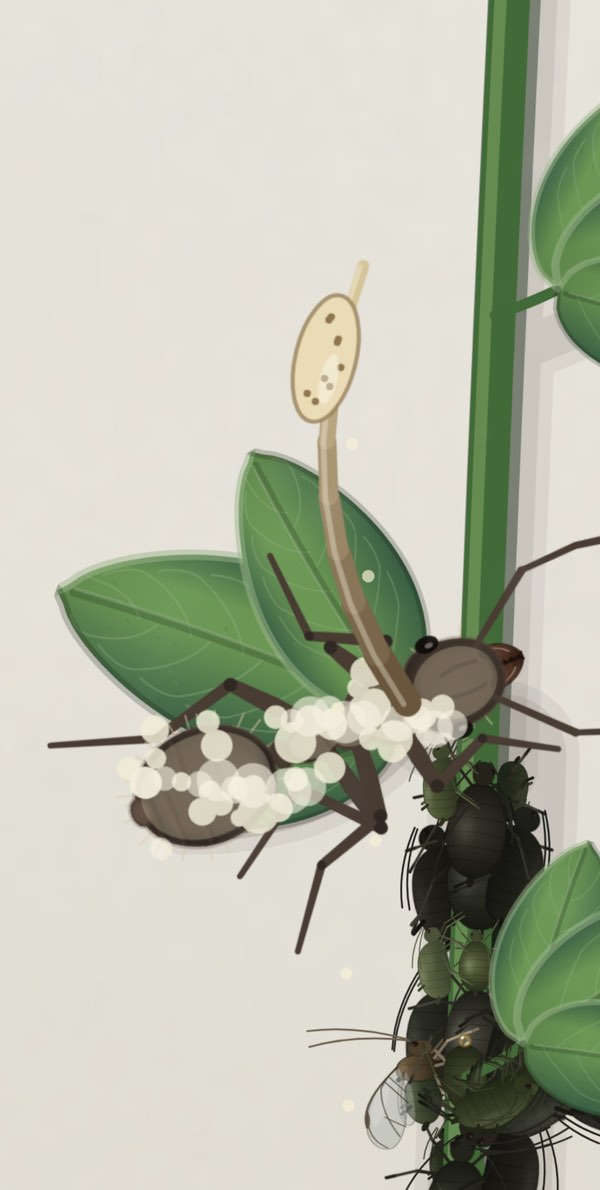
- The zombie-ant fungus. With the port open, a carpenter ant coming home can carry it in. Close the port to keep it out.
- A wolf spider. With the port open, one wanders in about once a month, and the ants deal with it.
- Little ant things: ants groom themselves and each other, share food mouth to mouth, feed the larvae and the queen, and help new workers out of their cocoons.
- Knock on the glass. A double tap startles the ants. A single tap never does.
- See where your ants came from. Every nest’s card tells how it began, and the Colony panel shows the family tree.
- The lodge: a glowing tank lamp, a light switch and a proper door.
- Experiments in the Lab: after a change, it tells you what to watch, then shows what happened.
- A Credits program on the lab computer, and Ant Facts that name their sources.
- Hide interface, for a clean view of your colony.
Better
- Ants find another way when their path is blocked.
- Brood and food carried in the jaws now sit between the jaw tips.
- The game uses less memory on phones and tablets, so it runs more smoothly.
- Many fixes, including blocked doors, food cards that jumped, and ants that drifted off the soil.
Read more in News.
Earlier: 2.0, The Naturalist
On the App Store since 19 October 2026
2.0 was the biggest update yet. The game has a new look, from clear glass controls to richer soil, carved tunnels and trees drawn anew. The sea, ponds and streams look like real water, and the island has day and night. The lodge comes alive: it is now its real size, a well-kept field station whose windows look out on your own island. Ants walk the floors, walls and glass of their rooms. You can examine an ant under a lens, read a field guide, keep a notebook beside the charts and close the access port again. On the island, your nests send out queens that found daughter colonies, wood ants grow into one supercolony, burnt land comes back green, and you can plant trees.
Your colonies come with you. Open one saved by 1.0.2 and it carries on where it was. Everything new starts as it was before: the heat mat under the whole floor, even watering, no winter rest and no notes. A few things look different straight away: the soil, the tunnels, the trees, the water and the lodge. Night falls slowly on its island too, unless you turn Sky off in Settings.
Watch the 2.0 trailer. 75 seconds, with sound. It plays only when you press play.
- A new look
- Water
- Day and night
- The lodge comes alive
- Ants in depth, and the farm close up
- Look closer
- The keeper’s notebook
- The ant farm
- The island
- The access port
- Feel and follow
- iPhone Duo
- Smaller fixes
A new look
Clear glass. The controls are clear glass over the colony, in forest green and brass. The bar, the status card, the place switcher, the zoom scale and the ant’s card float over the world. Panels you read, such as the colony panel, Data and Settings, are warm cream glass (dark forest glass in the dark theme). Whatever is on or open is marked in brass. Over pale ground the glass darkens so its words stay easy to read, and it follows Reduce Transparency and Increase Contrast in your device’s settings. If you prefer the look of earlier versions, choose Classic under Interface in Settings, Display: solid panels and bars, with everything new in 2.0 still there.
- A small status card shows the day, the workers and a dot for how the colony is doing.
- A weather chip low on the left gives the ant farm’s temperature, whether the soil is damp and whether the lamp is on. On the map and in a nest, it gives the weather outside.
- On iPad, + and − buttons zoom in and out.
- The ant’s card shows her inside a round lens with a brass ring.
One sun. Everything is lit from the upper left, as the lodge’s lamp is.
- The ant farm: richer soil with grains, pebbles and bits of root, the same at every zoom; tunnels and rooms that look carved, with shade on their walls; soft shadows under stones, plants and twigs (never under the ants); new plants on the surface, with birch and oak seedlings, daisies and heather. Plants grow out of the soil with roots, and grass has roots under it. Up close, the ants have a gloss on their sunny side, and a worker full of honeydew shows it amber through her swollen gaster. Reflections slide softly across the glass.
- Inside a nest: the soil matches the land outside, the tunnels look carved, and mould and springtails live in the chambers. On a big screen, more ants walk inside.
- The island: oak, birch and spruce drawn anew, with a look for every season; bushes and flowers, hawthorn too. Tree shadows grow longer in winter. Far land fades into a light haze, and cloud shadows fall on the land, never the sea. Young mounds start small and grow, huge nests look huge, and their traffic moves. The wood ants’ heap of needles stays sharp at every zoom, even close up. Panning the map is seamless: the picture slides along and only the strip that comes into view is drawn. Diving into a nest tilts the view down into it, leaves fall in autumn, and lightning flashes with its thunder.
Room names by zoom. The names of the rooms, in the ant farm and inside a nest, show when you are near enough to see the rooms, and fade away far out and close in among the ants. In Settings, Display, Room names can also be Always, When I tap or Off.
Water
The coast. The shore now follows a smooth line, not the map’s squares. Through the shallows you see the sea bed: sand with darker drifts, or stones and weed, then turquoise water over the sand, then deep blue. Each wave swells, breaks into a band of foam and runs up the beach in a thin sheet, and the wet sand darkens behind it. The sun glints on open water. Autumn’s leaves no longer lie on the open sea.
Ponds. Their shores are rounded and wander a little, with a soft wet edge. Close up you see stones and gravel in the shallows and leaves sunk on the bed, and in autumn floating leaves drift to the shore the wind blows them to. Ripples show only close up.
Streams. A stream now winds like a woodland stream: deep pools in its bends, shallow riffles between, a gravel bar on the inside of each bend, and banks that wander. Grass and sedge hang over the water, with moss and roots under the trees and patches of bare earth where a bank has slipped. You see the bed through clear water, darker and greener in the pools. Gleams of light ride down at the water’s own speed, quicker over the riffles, and close up the water piles against each stone, with a V of ripples and an eddy behind it. Where a stream reaches the sea it spreads across the beach and leaves a soft fan of silt.
Ice, rain and floods. Ice has cracks that wander and branch. Raindrops make small rings, many of them, only on the water. Floodwater on the map has drifts of silt, and inside a nest a flood is muddy, with bits of leaf and twig on its surface and rain dimpling it.
The sea and the seasons. The open sea is a little bluer on summer days and greyer in winter. Under a shower or a storm it turns dark slate, and close in, whitecaps run across it, more the harder it rains. Ponds and streams follow more lightly. The land’s light changes with the season too: warm in summer, golden as the leaves turn, cool in winter, with the snow kept white.
Day and night
The island now has night, and it comes slowly: one day and night takes about 12 minutes, whatever the game’s speed. The island grows dim towards a cool blue-grey, never black, and dawn and dusk are golden. Through the lodge’s windows and over a nest’s cut-away, the night sky turns deep blue-black, with stars and the moon. With Seasons on, days are longer in summer and shorter in winter. Fire and lightning glow at night. The ant farm keeps its own lamp, and the lodge’s room stays lamp-lit.
- In Settings, Display, Sky is Slow (the light changes over about 12 minutes and holds while the game is paused), My local time (night when it is night where you are), Time-lapse or Off.
- Slow and My local time only set the mood: the colony keeps its own faster days. On the map, each species’ workers come and go by its own hours as the sky’s night falls.
- Time-lapse is the light on the colony’s own quick days: deepest at 1× and 2×, very slight at 5× and 10×, a steady day at 25×.
- The weather chip shows a moon when the sky shows night.
- The light never changes fast enough to flash. With Off, or when your device asks for reduced motion, it is always day.
The lodge comes alive
Real size. The lodge is now drawn at its true size: a room about 3.8 metres wide, with the ant farm 58 cm long on its bench. On the map, the cabin is 3.8 by 2.8 metres.
A field station. On the map, the cabin is now a well-kept, working field station. Its standing-seam metal roof is a muted grey-green with clean gutters; snow lies on it in winter, a few leaves in autumn, and it shines wet in the rain. In the yard stand a timber step, a tidy woodpile, a labelled sample crate, a weather mast beside the white weather screen, its cups and vane turning in the island’s wind, a row of three solar panels with a battery box, and a small satellite dish. At dusk and at night, lamplight falls from its windows and door.
One light, and true-size things. The room has one light, and everything in it is redrawn at its real size: four food jars, a spray bottle, a magnifying lamp, the field guides on the shelf, soil samples and the keeper’s kit on the wall.
Windows onto your island. The two windows now look out on your own island, north of the lodge, as you would see it standing in the room. The ground rises and falls as the island does, in the colours of its land, from woods and meadow to heath and dunes. The map’s own trees stand where they are, at their size and stage, with your nests’ mounds and the wild colonies’ at their true size, and ponds, streams and the sea out to the horizon. Rows of field trees fill the middle distance, and soft hills rise behind the skyline where the land runs on. Burnt ground shows charred and then greening, and snow lies where the map lays it. Trees you plant show where you planted them.
Living windows. The nearest trees sway and the clouds drift in the same wind. Rain beads and runs on the glass, snow settles on the sill, frost creeps in, and the room greys on wet days. Storms flash in the windows. The view changes week by week through the year, with drifting leaves in autumn and petals in spring.
New window frames. Slim frames in the roof’s grey-green, each with one mullion and two tall panes of double glazing, a deep plastered reveal, and a solid oak window board where the jars and the pot stand.
Tap what is in it. In the lodge, tap a thing to use it. Rest the pointer on it, or press and hold on a phone, to see its name.
- The computer, or the census chart: opens Data.
- The thermometer: opens the climate chart.
- The watering can: opens Habitat.
- A food jar: opens Feed with that food picked.
- The books: open the field guide.
- The magnifying lamp: puts an ant you pick under the lens.
- The spray bottle: mists the farm by hand.
Eight tracks on the radio. The radio now plays eight tracks, all the developer’s own: Observations Accumulate, Observations Accumulate (II), Quiet Interior, Curious Discovery and the new Autumn Evening Warmth, Open Rhythmic Guitar, Espacio Abierto and California Dreaming (Surf Mix). It stays off until you tap it.
Ants in depth, and the farm close up
In the farm. The ants no longer all walk on one flat layer. Each worker keeps to one face of her tunnel or room for a while: most walk the floor, some a wall or the roof, some the back wall, and a few the glass in front. Those on the back wall are a little smaller and softer, in the shade of the room, partly hidden behind its rims; those on the glass are crisp and in full light. Each ant takes the shade of the soil where she is. The queen, nurses at the larvae, ants carrying brood and diggers at the face stay where they work. A tap finds the ant where you see her.
In outdoor nests. Some ants cross a room over its back wall instead of round its rim, and some rest out there, dimmed towards the wall behind them. Life is calmer: ants pause a moment on their way, each walks at a pace of her own, nurses rest by the brood and the queen’s attendants rest by her.
Sharp soil. At the closest zoom the farm’s soil now stays sharp, even when the game turns detail down to keep up. Its grains are small angular stones, its top edge crumbles, and the crumbs of dug soil are sharp too.
Mould that grows from its food. Mould now stands on the ground as it is drawn, not floating above it. Under each tuft and each mouldy piece of food lies a mat of fine threads, with threads reaching down into the soil. Food rests with its foot on the soil.
Look closer
Examine her. Tap an ant, then the round lens on her card. Her card tells her age (young, middle-aged or old), the day she was born, her nature, what she has practised and her length. Time stops while it is open.
Under the lens. From her card, tap Under the lens (or tap the lodge’s magnifying lamp). A soft brush lifts her into a small dish. She walks its rim, and a scale bar shows her true length. Tap a part of her body to learn its name. Put her back, and the brush sets her down exactly where she was. Nothing in the colony changes. The queen is never lifted out: she is examined where she is.
He is a “he”. A male ant’s card calls him “he”. Under the lens it says Put him back and His body, and it has his own lines for the antennae, jaws, eyes, head and thorax.
Find her in the crowd. A soft, pale silver patch on the ground beneath her marks the ant you follow. It shows in the ant farm, in the Ant cam, on the map and in a nest’s cut-away. The queen has her own marker, so she does not get this one.
The field guide. Open it from Data, from More on a phone, or from the books in the lodge. It opens at your species.
- A page for each of the six species, with plates of the worker, the major where there is one, the queen and the male, drawn at true size.
- Four chapters: the colony and its castes, founding a colony, egg to adult, and who does which job.
- Each page says what happens in the wild, gives real numbers, shows your own colony’s numbers beside them, and marks what the game simplifies and what is Experimental. Sources are listed. More chapters come later.
A goodbye. Follow a worker in the ant farm to the end of her life, and the game tells you how she died and the story of her life. The camera stays with her as a sister carries her out, then follows that sister. Pick another ant, or watch on in Cinematic mode.
The keeper’s notebook
Flags on the charts. Every time you change the lamp, the water, the warmth, the feeder, the seasons, the mist, a heat-mat or watering side, or give a winter rest, a small flag marks the day on the ant farm’s and the whole colony’s charts.
Your own notes. In Data, Field notes has a Keeper’s notebook: write a note of up to 140 characters for any day.
Compare. Next to a change, Compare shows the four weeks around it, with the averages before and after. The notebook exports as a CSV file with the rest of the records.
The colony’s health. The colony panel has a Growth line that says what is holding the colony back (or that nothing is), and a Colony health card of five tiles: brood, foragers, tidiness, food and deaths. The island card on the map uses the same Growth line.
The ant farm
Clean the farm. In Habitat, tap Clean the farm, then drag a finger (or the mouse) over the glass. A small nozzle lifts out the dead ants and spoilt food near its tip, through the open tunnels, rooms and air, never through soil, with a soft whirr. It never takes a living ant, brood, fresh food, the queen or anything an ant is carrying, and a body that has lain long on an old refuse heap has become soil and stays. Each clean is flagged in the keeper’s notebook. On a phone the camera closes in first, so the nozzle’s reach is a fingertip.
Mist by hand. In Habitat, under Water, tap Mist by hand and then a spot, or Whole farm to mist all along the lid. The spray bottle in the lodge does the same. It stops before the soil gets wet enough to drown eggs, and on automatic the mister gives that much less next time.
A warm end and a damp end. In Habitat the heat mat can lie under the whole floor, the left end or the right end, and the watering can be even or wetter at one end. A warm end is about 4 °C warmer than the far end. Thin strips along the base of the glass show where it is warm and where it is damp. Nurses carry pupae to the warmer, drier rooms, and eggs and young larvae to the damper ones. Plants, aphids and moss feel the difference too.
A winter rest. For black garden, wood, carpenter and harvester ants, with the heat mat on, Habitat has Rest the colony. The mat cools over about two weeks, holds for about two months and warms again over ten days. Workers age more slowly while they rest. Wake them now ends it early. Kept warm all year, these colonies still go quiet for a few weeks in late autumn, when the queen lays few eggs (with Seasons on). Harvester ants rest at a milder 15 to 18 °C.
Spoilt food. Food that has gone mouldy now stays spoilt: the ants will not eat it. Undertakers carry it to the refuse heap once the dead are cleared, or you can lift it out with tweezers from the food’s card. A new chart counts the insects eaten before they went mouldy.
Rich soil. An old refuse heap that held many dead turns, once it is left, into dark rich soil where moss and grass grow twice as fast, and pot mushrooms come up near it. (How fast is Experimental.) Not for harvester ants.
The queen moves to the middle of the nest. Once there’s room, as real queens do: when the colony has dug chambers well below her founding chamber, she walks down to one in the middle of the nest and her attendants carry the eggs after her. It becomes the queen chamber, and her founding chamber becomes a nursery. Inside the outdoor nests, a grown nest’s queen lives in a chamber in the middle too. Colonies from 1.0.2 do the same the first time there’s room.
The island
Daughter colonies. Your outdoor nests now join the mating flight. About one in a hundred young queens that land on free ground founds a colony of its own: your daughters, rivals like any neighbour. The island card counts them, the map labels them “(daughter)” and tints their land lighter, and Data charts them. Winged queens you let out of a closed ant farm count too. For species with one queen to a colony; at most 40 daughter colonies at once.
One supercolony. Wood ants take their young queens back into their own outdoor nests, many queens to a nest, and can grow to 150 nests. Fire ants can now start as one queen or many queens (the many-queen start is Experimental), with smaller nests closer together. The island card shows the supercolony’s nests and queens.
Burnt land comes back richer. Some months after a fire, the burnt ground turns green again and, for a season, feeds more than before. New nests, founding queens and newcomers favour it. A nest’s card shows how long ago its ground burnt.
Plant trees and shrubs. On the map, tap Plant (the leaf button, or P on a keyboard), choose Tree or Shrub and tap the ground. Aphids settle on it, and the ants farm them for honeydew; leafcutters cut its leaves and harvester ants take its seeds. A young tree takes about three years to grow, a shrub one summer and gives half as much. Nothing needs watering, but it can burn. Up to 40 in all.
Trees grow back. A tree a fire killed stands dead for a while, then falls, and a seedling grows up beside it over about three years, feeding the colony a little more each day. The tree’s card says how far it has grown. On the map, a burnt tree now looks fire-killed: the top of a charred trunk with a few broken limbs, greying as it stands, and a charred log once it has fallen.
Further scouts. As a colony grows towards its size in the wild, its scouts range further: from 36 metres to about 72 (100 for wood ants and leafcutters). The region card shows how far.
Majors when they can be afforded. Fire ants, leafcutters and carpenter ants raise their big-headed majors only once the colony is big enough, and more as it grows. A new chart shows the worker sizes. Big wood ant and leafcutter nests dig more chambers than before.
Each species keeps its own hours. Each species is out at its own time of day, which changes only what fire and lightning can catch. Activity by hour, in Data, shows it for the outdoor nests.
The access port
Close it again. Once open, the access port can be closed again: on the map, the colony’s card has Close it (on a phone, More has Close access port too). A stopper goes into the tube and the ant farm is a sealed colony again. The cost: outdoor nests cut off from the queen raise no more young, and over the months their workers grow old and the land goes back to the wild. Nests with a queen of their own, or joined to one by trails, carry on. Open it again at any time. You can see the cork in the tube, in the lodge and on the map.
Winged ants in a closed tank. In a contained or closed ant farm, the winged ants climb under the lid in flight season, and a card asks: Release them, or Keep them in. Released queens can found daughter colonies on the island.
Feel and follow
A tap you can feel. On iPhone, a gentle tap in your hand when your finger meets the ant farm, when the queen lands, when food you dropped lands, for a close crack of lightning, for the colony’s firsts and when you mist by hand. At most one every few seconds, none at 10× or 25× while running, and none in Cinematic mode. Letting the queen in has its own sounds too: a soft knock, then a thump and a puff of grains where she lands.
A steadier camera. The Ant cam and Follow hold still while she potters about, then glide after her, leaving room ahead.
iPhone Duo
Close the phone while a colony is in play, and the outer screen becomes a window onto the ant farm alone, with no controls. A tap brings them back; open the phone and you are where you were.
Smaller fixes
- On the map, a tap on the Formicarium label always goes into the ant farm. It could fly you to a wild colony under it.
- On a phone, Habitat, Weather, the radio’s card, the island card and the Feed strip no longer cover the zoom scale.
- On an iPhone Duo, a scenario card shrinks back when the phone is set down.
- Ants in the lodge’s tube walk at their own pace, carry what the land gives, and an ant you follow stays herself in the tube.
- Rain falls only in the lodge’s windows, leaning the right way, and the grey boxes behind the sack and tools are gone.
- Harvester, leafcutter and fire ant pupae are bare and called pupae, as in real life: their larvae spin no cocoon.
- Big islands run faster.
- On an iPad held sideways, the map’s bar keeps to one row now that it has Plant: the Formicarium button shows only its icon when room is short.
- The place switcher no longer says “Founding nest” twice, and on a phone the ant’s card shows her whole name.
- In the iPhone and iPad app, the screen stays on while the colony runs, so it no longer goes to sleep while you watch. Paused for two minutes, it sleeps as usual. You can turn this off in Settings, Display.
- With Low Power Mode on, the game lowers its finest detail sooner, so the radio’s music plays steadily.